
Crimp Terminal vs Copper Lug: Six Differences That Decide Your Choice
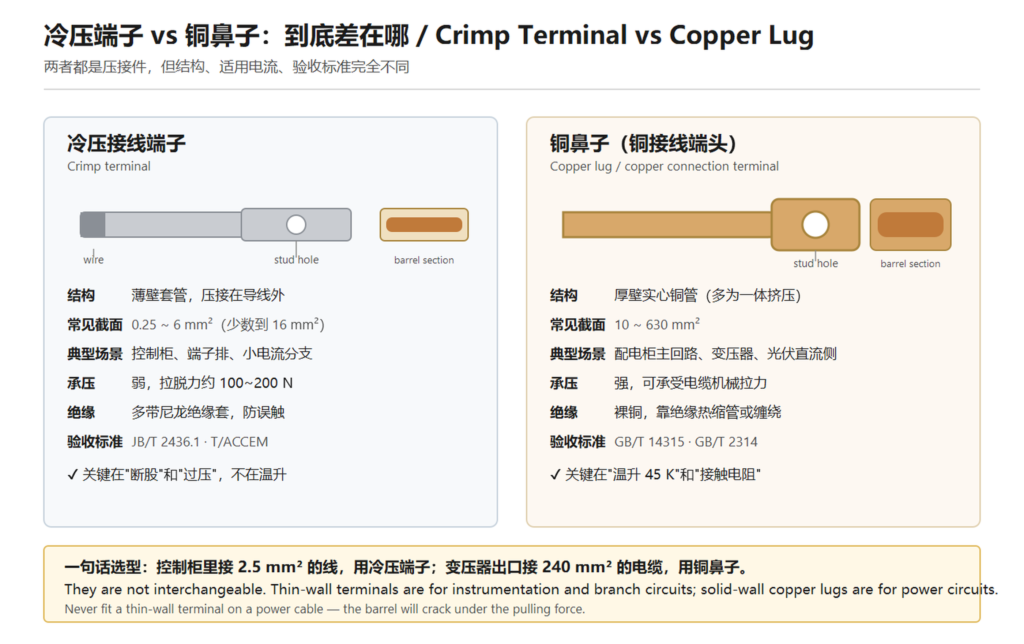
What is the difference between a crimp terminal and a copper lug? The question looks simple, but a bad answer causes real damage. The most common reply — “one is small, one is big” — is both inaccurate and dangerous, because what actually decides the matter is current rating and mechanical load, not size.
This article separates the two properly: structure, current capacity, acceptance standards and application. And it answers the more fundamental question — is a crimp terminal actually necessary?
I. The essential difference: a sleeve versus a solid tube
Setting aside model codes and appearance, these two diverge at the manufacturing stage:
A crimp terminal is a hollow sleeve stamped from thin copper strip. The strip is usually 0.3–0.8 mm thick, stamped into a barrel and hole, then rolled. At heart it is a metal cuff fitted over the conductor.
A copper lug (copper connection terminal) is a solid body extruded from copper bar or tube. The wall is millimetres thick, the tail closed or open, and there is no internal cavity. It is a genuine structural component able to carry the pulling force and the current of a heavy cable.
That difference produces everything else. A thin-wall sleeve is exactly right on a small conductor, because the conductor itself is strong enough to hold the connection. Only a solid copper part can take the tens of kilograms of pull and several hundred amps of a 240 mm² cable. Fitting a crimp terminal to a high-current main circuit is like carrying cement in a plastic bag.
II. Six dimensions side by side
| Dimension | Crimp terminal | Copper lug (copper connection terminal) |
|---|---|---|
| Manufacture | Stamped from thin copper strip | Extruded from copper bar / tube |
| Wall thickness | 0.3 – 0.8 mm | 1.5 – 4 mm |
| Typical cross-section | 0.25 – 6 mm² (a little to 16 mm²) | 10 – 630 mm² |
| Typical current | A few amps to tens of amps | Tens of amps to over a thousand |
| Mechanical strength | Weak — carries essentially no cable pull | Strong — carries the mechanical pull of the cable |
| Standards | JB/T 2436.1 / .2, T/ACCEM | GB/T 14315, GB/T 2314 |
The mechanical strength point deserves expanding, because it is the one most often overlooked and the one with the worst consequences.
A cable is not a rigid copper column. It has its own weight, its own torque, and it gets pulled around by installers during routing. On a 6 mm² conductor those forces are negligible. On a 240 mm² cable, four metres of it weighs tens of kilograms — and add the traction during pulling, and if the terminal cannot take it, that force ends up acting on the stud and the busbar. The busbar deforms, or the joint loosens and heats up.
A solid copper part handles that. A joint crimped into a thin-wall sleeve simply cannot. This is why “use a crimp terminal instead of a copper lug” has never been an option in high-current work — it is decided by structure, not by price.
III. The acceptance logic is different too
Many people assume the two differ only in current. In fact even the acceptance logic differs.
Crimp terminals worry about strand damage. JB/T 2436.1 splits cold-pressed connection terminals into two cross-section bands (0.5–6.0 mm² and 10–300 mm²). The T/ACCEM group standard requires a temperature rise at the crimped section of no more than 30 K, and a temperature-rise increment of no more than 8 K after 125 thermal cycles. The core risk is a mismatched die over-compressing the strands, or under-compressing them so the contact resistance climbs.
Copper lugs worry about heat. GB/T 2314 requires the temperature rise at the crimped section to stay within 45 K of ambient once the rated current has stabilised. GB/T 14315 covers the structure, material, surface treatment and mechanical performance of copper connection terminals. It is concerned with contact resistance, dimensional fit and coating integrity.
So there is an interesting split: for crimp terminals, acceptance centres on the crimping process; for copper lugs, it centres on material and fit. One fears the press, the other fears the purchase order.
IV. Which one do you need? A one-line rule
The decision is simpler than it looks. Look at where your load current falls:
| Load current | Conductor | Recommended | Why |
|---|---|---|---|
| < 10 A | 0.75 – 2.5 mm² | Crimp terminal (RV / UT / DBN / pre-insulated) | Quick to terminate, compact, sleeve prevents accidental contact |
| 10 – 63 A | 2.5 – 6 mm² | Crimp terminal (RV5 / UT5 / pre-insulated) | Still the terminal-block mainstream, easy to rework |
| 63 – 160 A | 10 – 35 mm² | Copper lug (OT / SC / DT) | Wall thickness and mechanical strength start to matter |
| 160 – 400 A | 35 – 95 mm² | Copper lug (OT / DT) | Solid construction is mandatory |
| > 400 A | 120 – 630 mm² | Copper lug (DT / large OT) | Only solid copper parts are available |
There is an even more intuitive test: look at how thick and heavy the cable is. If the cable in your hand is heavy enough to need two people to lift, it is copper lug work. The battlefield of the crimp terminal is the forest of thin wires inside a control cabinet.
V. Where a crimp terminal is not optional but mandatory
Now the more fundamental question: is a crimp terminal necessary?
The answer is: in four applications a crimp terminal is not “nice to have” but the standard practice — anything else fails the drawing and the acceptance test.
① Where space is tight and a screw is the only fixing
Terminal blocks, connection terminals, switch panels — there is no room for a stud and no current to speak of. A crimp terminal is terminated onto the wire, pushed into place, and clamped by one screw. On site that is extremely efficient.
② Circuits that are repeatedly dismantled and reworked
During commissioning, modification and component replacement, control wiring is taken apart and redone constantly. A screwed connection has to be re-tightened every time — threads strip, conductors get crushed; a crimped connection is simply cut off and re-crimped. This is exactly why control cabinets are full of crimp terminals while main circuits use screwed copper lugs.
③ Where there is vibration or movement
Automotive, rail, construction machinery, elevators — these environments vibrate continuously. A crimp terminal forms an integrated metal bond through cold welding, and in principle that resists vibration better than the frictional contact of a screw. USCAR-21 subjects every terminal to a vibration test (typically eight hours); if the terminal loosens, the resistance rises and the test fails.
④ Where the current is tiny but the wire count is huge
PLC inputs and outputs, sensor wiring, instrument signal loops — currents of a few tens of milliamps, but hundreds of connections. A screw terminal on every one of them turns a single PLC cabinet into several hundred screws to maintain. With crimp terminals on DIN-rail blocks, wiring and rework run an order of magnitude faster.
A few more applications where crimp terminals are simply better:
- Where accidental contact matters: the nylon sleeve on a pre-insulated terminal stops a slipped screwdriver from shorting the circuit. In automotive harnesses this is a hard requirement.
- Where space is very tight: micro terminals (0.1–0.5 mm²) fit inside instruments, sensors and LED drivers, where a screw terminal simply will not go.
- Where assembly is automated: a semi-automatic press terminates dozens of wires at once. No one can match that rate by hand-screwing terminals.
VI. When a crimp terminal is the wrong choice
In the other direction — the cases where using a crimp terminal is a mistake:
| Application | Why it fails | Use instead |
|---|---|---|
| High-current main circuits (>63 A) | A thin-wall sleeve cannot grip a heavy conductor; contact area is insufficient | Copper lug OT / DT |
| Cable carrying significant mechanical pull | Thin-wall sleeves lack tensile strength; the conductor pulls out | Solid copper lug |
| Transformer outgoing, oil-immersed equipment | Oil blocking is required; thin-wall construction has none | DT series (closed oil-block tail) |
| Direct copper-to-aluminium connection | Galvanic corrosion | Friction-welded bi-metal terminal |
| High current that must be disconnected frequently | A crimp is a permanent joint; dismantling means destroying it | Screwed copper lug and bolt |
| High temperature (>150 °C continuous) | Tin melts at 232 °C; nylon sleeve rating is insufficient | Silver-plated solid copper or a dedicated high-temperature terminal |
The “high current, frequently disconnected” case is worth stressing: a crimp is a permanent joint. To disconnect it you must cut it off and re-crimp, and a re-crimped joint is never as reliable as the first one. So where large connections must be broken and remade regularly, choose the screwed solution.
VII. The common combination you see on site
Real installations use both together, and once you see it, it makes sense:
A typical case: a VFD feeding a motor. The VFD output is three shielded cables of 25 mm² or 50 mm² terminating at the motor terminal box. Those use copper lugs (usually OT or ring type), because the current is high and the cable is heavy.
But in the same cabinet, the control wiring from the breaker to the VFD control terminals uses crimp terminals landing on DIN-rail terminal blocks.
So the cabinet shows half heavy copper lugs bolted onto copper bars, and half dense rows of small crimp terminals in white terminal blocks. That is not a mess — it is correct division of labour by current rating.
Wrapping up
Back to the question: what is the difference between a crimp terminal and a copper lug?
One line: a crimp terminal is a thin-wall sleeve built for fine conductors, small currents, frequent rework and vibration; a copper lug is a solid copper part built for heavy cables, high currents, mechanical pull and harsh environments.
And “is a crimp terminal necessary?” answers like this: in control circuits, signal circuits and anywhere with frequent maintenance or vibration, it is not an option but the standard practice; in main circuits and heavy loads, it should not appear at all.
So the useful question is not “do we use crimp terminals”, but “what current and mechanical load does this circuit carry, and therefore which class of part belongs on it“. Answer that correctly and the wiring in the cabinet carries no hidden risk.
To go deeper: the crimping procedure is in How to Crimp a Cold-Press Terminal: The Five-Step Method; model codes in Crimp Terminal Model Codes Explained; materials and plating in What Are Crimp Terminals Made Of?